
The ‘Buckley’ dial and its enduring appeal.
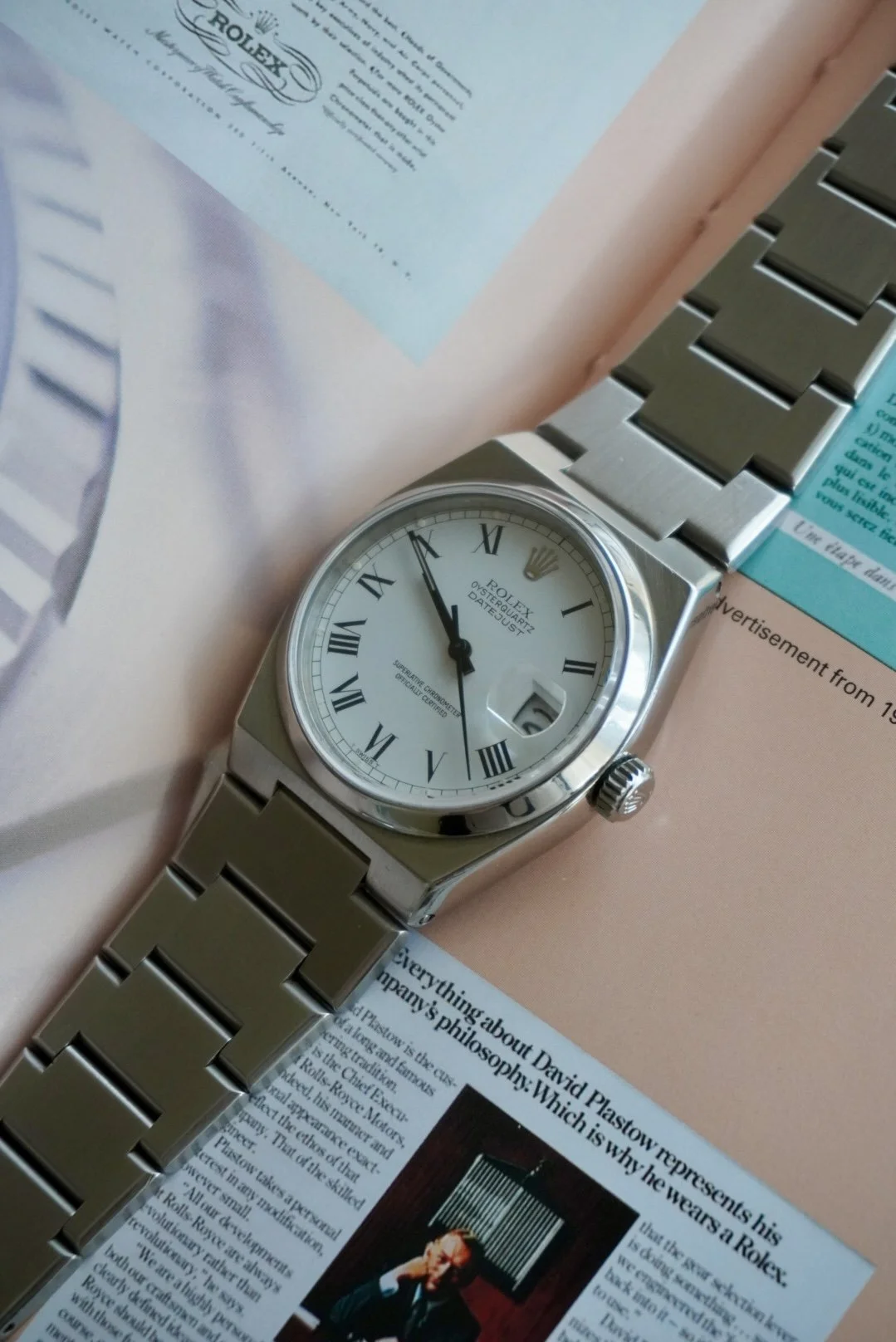
The understated detail that continues to shape collector taste.
For this article, I will be turning my attention to a term many watch enthusiasts will recognise, the “Buckley.” A mildly sophisticated dial brought into the spotlight by a Rolex connoisseur Mr John Buckley. Carrying the quiet refinement that we all expect from a date just yet fronted by bold black or in some cases white printed roman numerals that feel more expressive than traditional. It offers the familiar Rolex confidence but with a dial that sits falter, cleaner and far more alive than convention would suggest.
Why was the ‘Buckley’ dial created?
The simple answer to this question is innovation. Rolex is a highly established and deep-rooted brand that managed to create a culture with their incessant innovations such as this stamped Roman numeral dial.
Although there is no official statement from the brand as to why the Buckley Dial was made, there are two theories:
The first theory is that the ‘Buckley’ dial was designed to improve legibility, with black paint on white dials as opposed to silver markers, and white paint on black or blue dials. Rumour has it, this is like what Hans Wilsdorf did when he created the date window for the Datejust so his wife could read the date on her watch.
The other theory is that they were trying to make the Rolex Datejust appeal to a younger market by making it less ‘dressy’ with printed dials. At first, collectors worldwide considered the dial to be a hybrid that was not dressy and not sporty either.
Overall, both theories hold weigh, and together they reinforce Rolex as living proof that the brand has always been willing to think beyond convention in the name of genuine innovation.
It is widely accepted that references 1601, 1603, 16014, and 16030 were originally delivered with Buckley dials. These configurations typically feature either black or white hands and indices, each offering its own character. Two Rolex models were fitted with what collectors now call the ‘printed Roman’ Buckley dial: the Day‑Date and the Datejust Oyster Perpetual.
While they are possible to source, Buckley‑dial Datejusts and Day‑Dates remain scarce. This is partly due to their production era, which was during the 1970s and 1980s, but also because buyers at the time did not respond enthusiastically to the printed‑Roman aesthetic. As a result, far fewer were produced compared with their applied‑marker counterparts.
The black‑hand variant tends to be the favourite among collectors, largely because the stark contrast between the dark elements and the light dial gives the watch a sharper, more defined presence.
This is why the ‘Buckley’ dial matters. Every collector has a moment when a watch stops being an object and becomes like a PHD study. For Alex, founder of Vision Vintage and one of the most experienced eyes in the vintage watch world, that moment often begins with a vintage Rolex.
When it comes to the ‘Buckley’ dial, what draws him in is not just the typography or the Roman numerals; it is the nuance. The way colour shifts over decades. The way certain finishes age differently. The way a dial can tell you quietly, that it once lived and continues to live even today!
“I’ve had some rare variants over the years,” he says, “including a black‑to‑brown bi‑metal 1601. I think possibly unique.” It is the kind of remark only a seasoned curator can make, not boastful just observational.
“Once you start collecting Buckleys,” he explains, “patterns emerge. The blue dials for instance, are notorious for flaking because of the finish Rolex used. Finding one that has survived cleanly is now exceptionally rare.” But it is not all doom and gloom! A splendid example is available at Fluted London for just under £5K.
Among his favourites is the classic white on black 1603 with a machine‑turned bezel, a configuration that feels almost architectural in its restraint. “It’s an example of clean design,” he notes. “The black outer minute track, the black gloss hands on a bone‑white dial… even better with warm patina and preferably on Oyster.” It is a combination that captures the essence of the Datejust, functional elegance with just enough attitude.
Buckleys sit within the most accessible Rolex line, yet they carry a subtle twist. The painted Roman numerals give them a classical inflection and a quiet deviation from the applied markers and baton hands that dominate the Date just family. They go against the grain in a way that feels intentional rather than loud.
And that deviation is not random. As Alex points out, the painted‑marker approach echoes Rolex’s early design language from the 1940s, the non‑lume Oysters and Bubble backs that relied on printed. “There’s a throwback to early design literature,” he says, and once you see it, you cannot unsee it. The Buckley dial becomes not just a variant, but lineage.
That is the charm, a dial that feels both familiar and slightly rebellious. A Datejust that honours the past while standing apart from the crowd. A reminder that sometimes the most timeless details are the ones painted by hand.
And, as ever I am grateful to Alex from Vision Vintage watches for answering my endless questions and reminding me that even the best curators never stop learning.
